

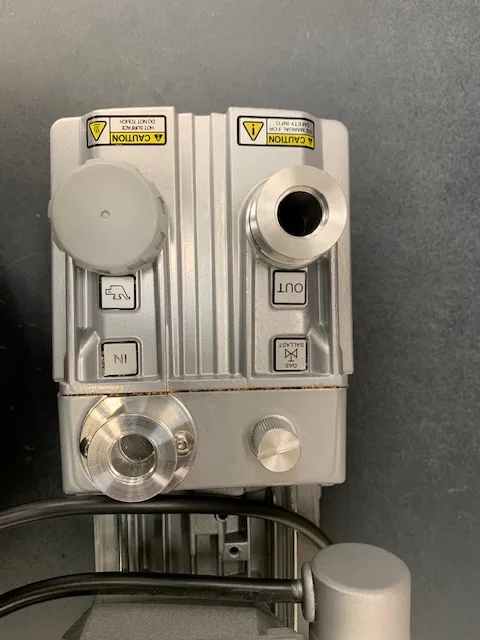
A single-stage rotary vane pump has one compression stage and reaches an ultimate vacuum of around 10-1 mbar; a two-stage pump passes the gas through two stages in series and reaches around 10-3 mbar — a deeper, more stable vacuum. Choose single-stage for rough and medium duty at high throughput, and two-stage where you need a deeper, cleaner vacuum.
How each works
Both use an offset rotor with sliding vanes running in an oil-sealed chamber. A single-stage pump compresses and exhausts in one step. A two-stage pump feeds the outlet of the first stage into a second, so the final stage works against a much lower pressure and reaches a deeper ultimate vacuum.
Ultimate vacuum compared
| Single-stage | Two-stage | |
|---|---|---|
| Ultimate vacuum | ~10-1 mbar (e.g. Edwards nES 0.5 mbar, DVP RC.8M 0.1 mbar) | ~2×10⁻³ mbar (e.g. Edwards E2S) |
| Best for | High throughput, rough/medium vacuum | Deeper, cleaner vacuum |
| Typical uses | Large chambers, degassing, industrial | Freeze-drying, lab vacuum, backing turbos |
When to choose single-stage
Single-stage pumps often move more gas for the money and suit large-volume, rough-vacuum duty where you don’t need to go below ~0.1 mbar — degassing, large chambers, general industrial extraction.
When to choose two-stage
Choose two-stage when the process needs a deeper or more stable vacuum — freeze-drying, laboratory work, or as a backing pump for a turbomolecular pump. It’s the more common choice in labs.
Cost and maintenance
Both are oil-sealed, so both need regular oil changes and occasional vane and seal replacement. Two-stage pumps cost a little more but are usually worth it where vacuum depth matters. Girovac supplies and services both from Edwards, Leybold and DVP.
Single or two-stage for your job?
Tell us your target vacuum and gas load and we’ll recommend the right pump – new or reconditioned. Email [email protected] or request a quote.
Frequently asked questions
What is the difference between single-stage and two-stage rotary vane pumps?
A single-stage pump compresses gas once and reaches about 10^-1 mbar; a two-stage pump uses two stages in series and reaches about 10^-3 mbar – a deeper, more stable vacuum.
Which reaches a deeper vacuum, single or two-stage?
A two-stage rotary vane pump – typically around 2×10^-3 mbar, compared with about 0.1-0.5 mbar for a single-stage pump.
Do I need a two-stage rotary vane pump?
Choose two-stage if you need a deep or stable vacuum, for freeze-drying, laboratory work or backing a turbo pump. For high-throughput rough vacuum above about 0.1 mbar, a single-stage pump is often more cost-effective.
Written by the Girovac technical team. Girovac Ltd has supplied and serviced industrial and laboratory vacuum equipment from its North Walsham workshop since 1983. Last updated: July 2026.