

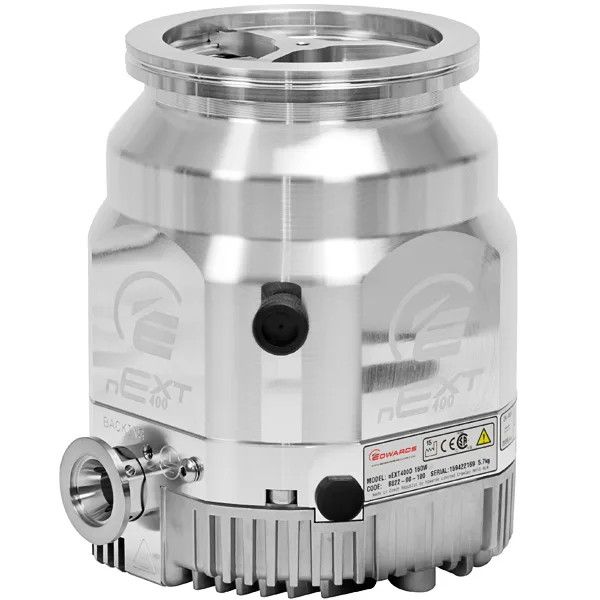
There are three broad families of vacuum pump: positive-displacement pumps (rotary vane, scroll, diaphragm, claw, piston and Roots), momentum-transfer pumps (turbomolecular and diffusion) and entrapment pumps (cryo and ion). The right choice depends on two things above all — the vacuum level your process needs, and whether it must be oil-free. This guide explains each type, its typical operating range and where it is used.
The main types of vacuum pump at a glance
| Pump type | Oil-free? | Vacuum regime | Approx. ultimate pressure* | Typical uses |
|---|---|---|---|---|
| Rotary vane (oil-sealed) | No | Rough–medium | ~10-1 mbar (1-stage) / ~2×10⁻³ mbar (2-stage) | Labs, freeze-drying, backing pump, general industry |
| Dry scroll | Yes | Rough–medium | ~10-2 mbar | Clean/oil-free labs, analytical, backing pump |
| Diaphragm | Yes | Rough | ~0.5–100 mbar | Chemistry labs, filtration, rotary evaporation |
| Claw (dry) | Yes | Rough–medium | ~60 mbar | Packaging, food, continuous industrial duty |
| Liquid ring | Yes (liquid-sealed) | Rough | ~30 mbar | Wet/vapour-laden processes, chemical |
| Roots (booster) | Yes | Medium–high | To 10-4 mbar (with backing pump) | Boosting speed on a backing pump |
| Turbomolecular | Yes | High–ultra-high | 10-7 to 10-10 mbar (with backing pump) | Analytical instruments, R&D, coating |
| Diffusion | No (uses fluid) | High | 10-6 to 10-9 mbar (with backing pump) | Coating, furnaces, established high-vacuum systems |
Understanding vacuum ranges first
Before choosing a pump, it helps to know which vacuum regime you are working in. Vacuum is measured in millibar (mbar); lower numbers mean deeper vacuum.
- Rough (low) vacuum: atmosphere down to ~1 mbar
- Medium vacuum: 1 to 10-3 mbar
- High vacuum: 10-3 to 10-7 mbar
- Ultra-high vacuum (UHV): below 10-7 mbar
No single pump spans every regime. High- and ultra-high-vacuum pumps need a backing pump to work — which is why many systems combine two pump types.
Positive-displacement pumps (rough & medium vacuum)
These pumps trap a volume of gas and physically move it out, repeating the cycle to lower the pressure. They are the workhorses of rough and medium vacuum.
Rotary vane pumps (oil-sealed)
The most common industrial and laboratory vacuum pump. A rotor with sliding vanes sweeps gas through an oil-sealed chamber. Single-stage pumps reach around 10-1 mbar — for example the Edwards nES and DVP RC.8M reach roughly 0.1–0.5 mbar — while two-stage pumps go deeper, to around 2×10⁻³ mbar (as on the Edwards E2S), with high pumping speed and quiet running. They are widely used for freeze-drying, laboratory vacuum and as backing pumps. Girovac supplies and services rotary vane pumps from Edwards, Leybold and MIL’S (the oil-lubricated EVISA range).
Dry scroll pumps
Two interleaved spirals compress gas without any oil in the pumping chamber, reaching around 10-2 mbar. They are quiet, oil-free and a popular clean backing pump for turbomolecular pumps — ideal where oil contamination cannot be tolerated.
Diaphragm pumps
A flexible diaphragm flexes to move gas, giving completely oil-free operation down to roughly 1 mbar (multi-stage). They are the standard choice for chemistry labs, vacuum filtration and rotary evaporation, and for chemically aggressive duty. Girovac services and sources spares for KNF and VacuuBrand diaphragm pumps.
Claw, liquid-ring & side-channel pumps
Dry claw pumps run continuously with no wearing contact, suiting packaging, food and heavy industrial duty; the Busch MINK claw, for example, reaches around 60 mbar. Liquid-ring pumps tolerate wet, vapour-laden gas streams. Side-channel blowers move high volumes at modest vacuum. Several of these technologies appear in the MIL’S medium-vacuum range, and Girovac services Busch and Rietschle claw and rotary vane pumps.
Roots (booster) pumps
A Roots pump uses two figure-of-eight rotors to move large gas volumes quickly. It is not used alone — it sits on top of a backing pump to boost pumping speed and extend the system into high vacuum, down to around 10-4 mbar.
High- and ultra-high-vacuum pumps
Below about 10-3 mbar, positive-displacement pumps run out of capability and a second-stage pump takes over — always on top of a backing pump.
Turbomolecular pumps
A “turbo” spins bladed rotors at very high speed to knock gas molecules towards the exhaust, reaching high and ultra-high vacuum with a suitable backing pump. The Leybold TURBOVAC i, for instance, reaches an ultimate pressure of ≤8×10⁻⁸ mbar (and ≤5×10⁻¹⁰ mbar on the iX variant), with pumping speeds from 90 to 1390 l/s. Leybold built the first molecular pump — the ancestor of today’s turbo — back in 1909. They are the standard for analytical instruments, research and coating. Girovac is an authorised distributor for the Edwards nEXT and Leybold TURBOVAC turbomolecular ranges.
Diffusion pumps
Diffusion pumps use a heated fluid vapour jet to drag gas molecules downwards. With no moving parts they are robust and reach 10-6 to 10-9 mbar, and remain common on coating plant and furnaces. They also need a backing pump.
Capture (entrapment) pumps
Cryo, ion and getter pumps trap gas molecules on cold or reactive surfaces rather than moving them out. They are specialist UHV pumps used in surface science and semiconductor research.
Oil-sealed vs oil-free: which do you need?
If any oil back-migration would ruin your process — clean labs, food, pharmaceuticals, analytical work — choose an oil-free pump (dry scroll, diaphragm or claw). If you need the deepest single-pump vacuum and highest speed at lowest cost, an oil-sealed rotary vane pump is usually the answer. For a worked example, read our guide on choosing between an oil-free and a lubricated pump (Sirella vs Evisa).
How to choose the right vacuum pump
Work through five questions:
- What vacuum level do you need? This narrows the pump family immediately.
- Oil-free or oil-sealed? Driven by contamination sensitivity.
- What pumping speed / chamber volume? Bigger or faster jobs need more speed, or a booster.
- What’s in the gas stream? Vapours, solvents or particulates change the pump (and accessories such as a gas ballast or condenser).
- Duty cycle and running cost? Continuous duty and energy use favour some technologies over others.
If you’re unsure, tell us your application and we’ll specify it. Browse our vacuum pumps or ask for advice.
Buying, servicing & reconditioning vacuum pumps in the UK
Girovac has supplied, serviced and reconditioned industrial and laboratory vacuum equipment since 1983 — more than 40 years across every major pump type. We are the authorised UK distributor for Edwards, Leybold and MIL’S, and we service, repair and source spares for Busch, Pfeiffer, Alcatel, KNF, Gast, VacuuBrand, DVP and Rietschle. Whether you need a new pump, a reconditioned unit or a workshop repair, our engineers can help.
Not sure which vacuum pump you need?
Tell us your application, target vacuum level and whether it must be oil-free, and we’ll recommend the right pump — new, reconditioned or repaired. Email [email protected] or request a quote.
Frequently asked questions
What is the most common type of vacuum pump?
The oil-sealed rotary vane pump is the most common in industry and laboratories. It is reliable, achieves medium vacuum (around 2×10⁻³ mbar for a two-stage pump, such as the Edwards E2S) and offers high pumping speed at a low cost.
What is the difference between oil-sealed and oil-free vacuum pumps?
Oil-sealed pumps (rotary vane) use oil to seal, lubricate and cool, achieving deeper vacuum at lower cost but with a risk of oil back-migration. Oil-free pumps (scroll, diaphragm, claw) have no oil in the pumping chamber, so there is no contamination risk — essential for clean, food and pharmaceutical processes.
Which vacuum pump reaches the deepest vacuum?
Turbomolecular and diffusion pumps reach the deepest vacuum — high and ultra-high vacuum, from 10-6 down to 10-10 mbar — but both require a backing pump to operate.
Do I need a backing pump?
Yes, for high- and ultra-high-vacuum pumps. Turbomolecular, diffusion and Roots pumps cannot exhaust to atmosphere on their own; they need a backing (roughing) pump such as a rotary vane or scroll pump beneath them.
Which vacuum pump is best for a laboratory?
It depends on the work: diaphragm pumps for chemistry, filtration and rotary evaporation; two-stage rotary vane or scroll pumps for freeze-drying and general vacuum; and a turbomolecular pump backed by a scroll pump for high-vacuum analytical instruments.
Written by the Girovac technical team. Girovac Ltd has supplied and serviced industrial and laboratory vacuum equipment from its North Walsham workshop since 1983. Last updated: July 2026.