

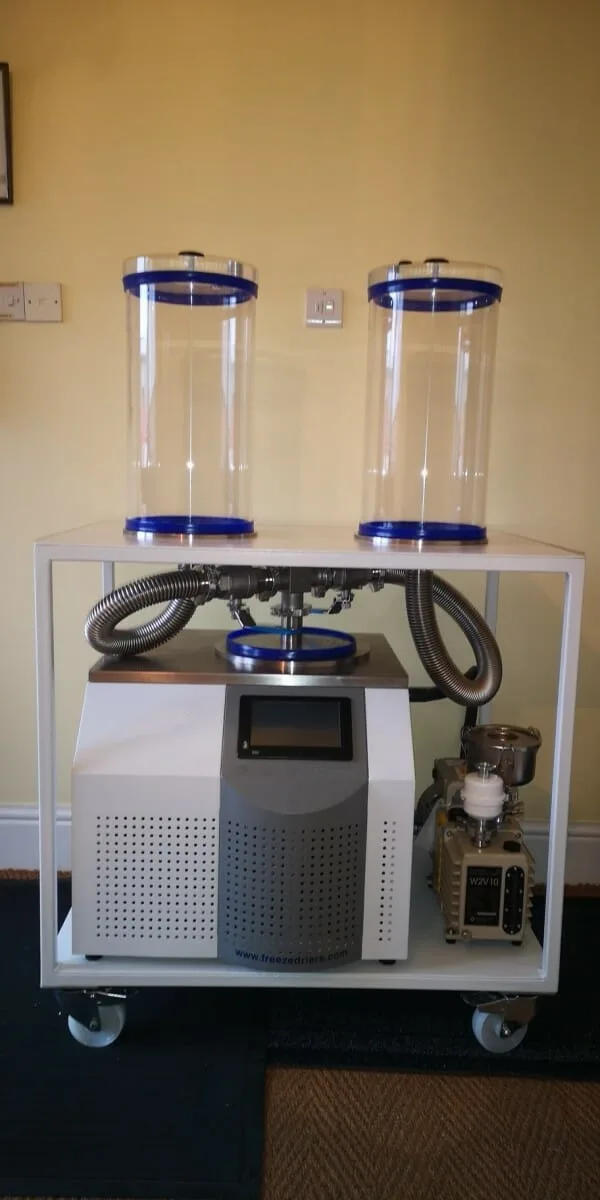
For freeze drying, use a two-stage rotary vane pump (or a chemical-duty dry scroll pump) that reaches around 10-3 mbar, fitted with a gas ballast and a cold trap to handle water vapour. For rotary evaporation, a controllable, oil-free diaphragm pump in the ~1–20 mbar range is usually the right choice. The two applications have very different needs, so matching the pump to the job matters.
What vacuum level does each need?
Freeze drying (lyophilisation) needs a deep, stable vacuum — typically below the triple point of water — so the process runs in the medium-vacuum range around 10-2 to 10-3 mbar. Rotary evaporation removes solvent at a controlled, much softer vacuum, often 1–100 mbar depending on the solvent’s boiling point. If you’re new to pump ranges, our guide to the types of vacuum pump explains the regimes.
Freeze drying: two-stage rotary vane or chemical scroll
A two-stage rotary vane pump is the traditional choice: high pumping speed and a deep ultimate vacuum. The catch is water — freeze drying releases a lot of vapour, which condenses in the oil and destroys performance. So you must:
- open the gas ballast to help the pump clear vapour;
- fit a cold trap between the dryer and the pump to freeze out water before it reaches the pump;
- change the oil more often (see how often to change vacuum pump oil).
Where oil contamination cannot be tolerated, a chemical-duty dry scroll pump gives oil-free operation to around 10-2 mbar. Girovac supplies and services rotary vane pumps from Edwards, Leybold and MIL’S.
Rotary evaporation: oil-free diaphragm pump
Rotary evaporation is a chemistry application, so the pump must resist solvents and stay clean — which rules out oil-sealed pumps. A chemical-resistant diaphragm pump with an integrated vacuum controller lets you dial in the exact vacuum for each solvent, protecting bumping and giving reproducible results. Girovac services and sources spares for KNF and VacuuBrand diaphragm pumps.
Oil-sealed or oil-free?
The deciding question is contamination tolerance. Freeze dryers often accept an oil-sealed pump (with a trap); chemistry rigs almost always need oil-free. For a worked comparison, read choosing between an oil-free and a lubricated pump.
Sizing the pump
Match pumping speed to chamber size and how quickly you need to pump down, and allow headroom for vapour load. Undersized pumps struggle; oversized ones waste money and energy. If in doubt, tell us the process and we’ll specify it.
Not sure which pump suits your process?
Tell us your application, solvent or product and target vacuum, and we’ll recommend the right pump – new or reconditioned. Email [email protected] or request a quote.
Frequently asked questions
What vacuum pump is best for a freeze dryer?
A two-stage rotary vane pump reaching about 10^-3 mbar, used with the gas ballast open and a cold trap to handle water vapour. Where oil-free operation is essential, a chemical-duty dry scroll pump is a good alternative.
What vacuum pump is best for a rotary evaporator?
A chemical-resistant, oil-free diaphragm pump with an integrated vacuum controller, typically operating in the 1-20 mbar range so you can match the vacuum to each solvent.
Do I need a cold trap for freeze drying?
Yes – a cold trap between the freeze dryer and the pump freezes out water vapour before it reaches the pump, protecting the oil and maintaining vacuum. It is strongly recommended for any wet process.
Written by the Girovac technical team. Girovac Ltd has supplied and serviced industrial and laboratory vacuum equipment from its North Walsham workshop since 1983. Last updated: July 2026.