

A turbomolecular pump transfers gas from a high-vacuum chamber to its outlet. A backing pump removes that gas and keeps the outlet pressure within the turbo’s operating limits. The turbo cannot discharge directly to atmospheric pressure.
In many systems the same backing pump also performs roughing: the initial evacuation from atmospheric pressure. Roughing and backing describe different duties. The pipework, valves and starting sequence must suit the equipment.
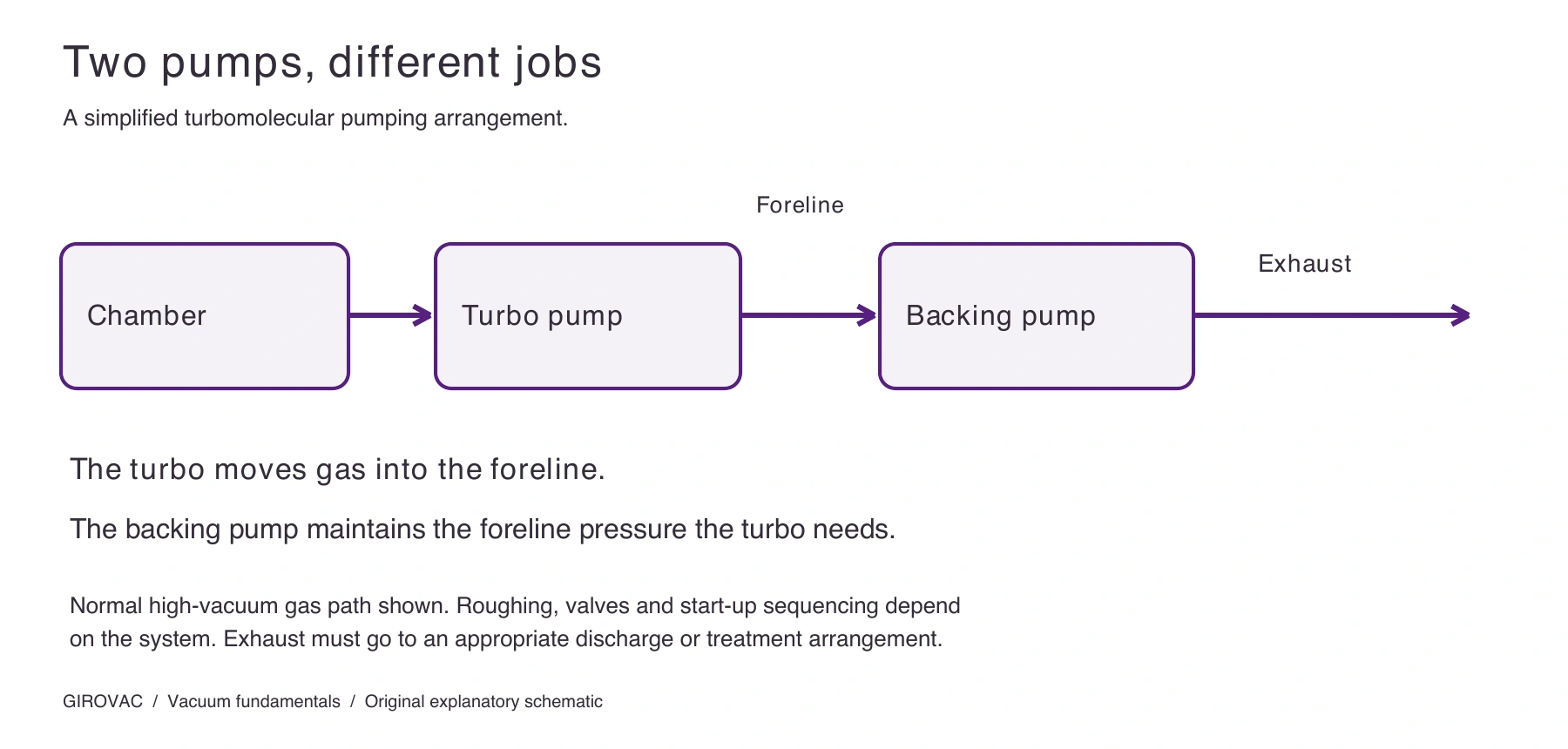
What each pump does
Inside the turbo, rapidly rotating blades transfer momentum to gas molecules. Successive stages direct gas towards the outlet, where pressure is higher than at the chamber inlet.
The backing pump maintains a suitably low outlet pressure and carries gas onwards to the exhaust. The connecting pipe is called the foreline or backing line. Its pressure is the backing pressure or forevacuum pressure.
Chamber → turbomolecular pump → backing line → backing pump → exhaust
This shows the gas path during normal high-vacuum operation. Initial evacuation follows the specified system arrangement. Exhaust treatment depends on the gases being handled.
Why backing is more than a starting aid
Even after the chamber reaches high vacuum, gas may enter from the process, escape from surfaces or pass through small leaks. That gas continues through the turbo to the backing pump.
If the backing pump cannot remove it at the required rate, backing pressure rises. Selection has to cover both initial evacuation and the operating gas load. A combination that performs well on an empty chamber may behave differently when process gas is introduced.
Matching the pumps
The two quoted pumping speeds apply at different pressures. Gas is compressed as it passes through the turbo. The backing pump handles it at a higher pressure, where it occupies a smaller volume, so its volumetric speed can be much lower than the turbo’s.
The relevant quantity is gas throughput: pressure multiplied by pumping speed. Under steady conditions, at approximately the same gas temperature and without extra gas entering between pumps, the same throughput passes through both.
Selection also needs to cover the permitted backing pressure, the backing pump’s speed at that pressure, gas type, maximum process flow, specified purge gas, startup loads and losses along the backing line. The maximum permitted backing pressure is a limit, not the desired operating point.
A model-specific example
Leybold’s supplied May 2024 operating instructions list a maximum forevacuum pressure of 14 mbar for nitrogen for the TURBOVAC 250 i/iX. This is a model- and gas-specific limit, not a general backing-pump selection rule.
The manual lists TRIVAC D 2.5 E / D 4 B, SCROLLVAC SC 5 D / SC 15 D and DIVAC 3.8 HV3 among the recommended backing options for the 250 model. The appropriate arrangement still depends on the application. See the TURBOVAC 250 i/iX specifications and performance graph and manufacturer manual (PDF), pages 19–22.
Does the backing pump have to be dry?
Dry backing pumps can be useful where oil contamination is a concern. Oil-sealed rotary vane pumps can also be suitable where their characteristics and the system’s contamination controls meet the requirements.
Check the selected pump’s suitability for the gases and vapours involved. A dry mechanism does not establish compatibility with every chemical or particulate load. For the turbo, use gas-specific data rather than assuming nitrogen figures apply to hydrogen or helium.
Separate pumps or a complete station?
A complete turbomolecular pumping station can simplify selection by bringing the turbo, backing arrangement and controls together in a defined configuration. Check the exact configuration and whether the backing pump is included.
The chamber connection, evacuation time, process gas, cooling and cleanliness requirements still determine suitability. Send Girovac the application details and, for an existing installation, the full turbo and backing-pump model designations.
Technical reference: Leybold, Fundamentals of Vacuum Technology, 2016 edition, sections 2.1.7 and 2.3.2. Leybold’s online vacuum fundamentals provides further reading.
Additional reference: High, Ultra-high & Extreme High Vacuum: The fundamentals, June 2024, pages 7–9.
Updated September 2026. Model-specific settings and limits must be checked against the equipment’s operating instructions.