

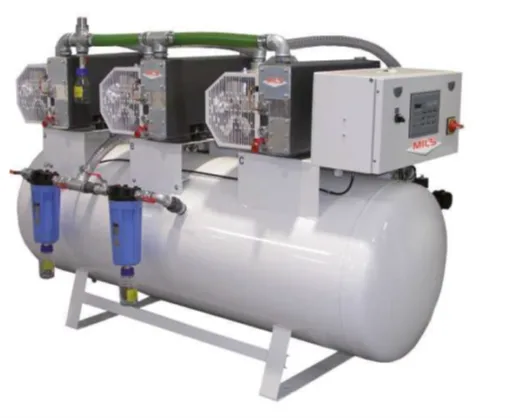
In the UK, medical (surgical) vacuum is part of the hospital’s Medical Gas Pipeline System (MGPS) and is governed by the Health Technical Memorandum HTM 02-01. A compliant medical vacuum plant is typically a duplex (duty/standby) system with a vacuum receiver and bacterial filtration, sized so that a single pump can carry the whole hospital’s demand while the second provides full back-up.
What medical vacuum is used for
Medical vacuum provides clinical suction throughout a hospital — theatres, wards, recovery and ICU — for airway and wound suction, fluid removal and drainage. Because it is a life-critical service, availability and cleanliness are paramount, which is why it is designed and validated to a national standard rather than assembled ad hoc.
The UK standard: HTM 02-01 and MGPS
HTM 02-01 covers the design, installation, validation, operation and maintenance of medical gas pipeline systems, including medical/surgical vacuum. It sets the framework for how the vacuum plant, pipeline, terminal units and alarms are specified and verified. Specific design figures and test requirements should always be taken from the current edition of HTM 02-01 and confirmed with a competent person (an Authorised Person for MGPS).
How a medical vacuum plant is configured
- Duplex or triplex pump set: multiple vacuum pumps, arranged so one unit can meet full demand with the others on standby, giving redundancy for a critical service.
- Vacuum receiver: a reservoir that smooths demand and helps maintain a stable vacuum.
- Bacterial filtration: filters protect the plant and the discharge.
- Control and alarms: automatic pump sequencing with plant and area alarms.
Anaesthetic gas scavenging (AGSS) is a separate system — it is not the same as medical vacuum and must not be cross-connected.
Which pumps are used?
Medical vacuum plants commonly use dry claw, oil-sealed rotary vane or liquid-ring pumps, chosen for reliability and continuous duty. Dry pumps are popular for cleanliness and lower maintenance; oil-sealed pumps offer strong performance where servicing is well managed. Our guide to vacuum pump types explains the trade-offs.
Servicing and reliability
Because medical vacuum is life-critical, planned maintenance and prompt repair are essential. Girovac supplies, services and reconditions the vacuum pumps used in medical and laboratory vacuum plant, and holds a range of medical vacuum systems and pumps. We work alongside your estates team and MGPS competent persons — we service and supply the pumps; system validation remains with your Authorised Person.
Need medical vacuum pumps, spares or servicing?
We supply and service the vacuum pumps used in UK medical and laboratory vacuum plant. Email [email protected] or request a quote.
Frequently asked questions
What standard governs medical vacuum in the UK?
Health Technical Memorandum HTM 02-01. Medical (surgical) vacuum is part of the Medical Gas Pipeline System (MGPS), and HTM 02-01 covers its design, installation, validation, operation and maintenance.
What is MGPS?
MGPS stands for Medical Gas Pipeline System – the pipework, plant, terminal units and alarms that distribute medical gases and vacuum around a hospital. Medical vacuum is one of the services within it.
Is anaesthetic gas scavenging the same as medical vacuum?
No. Anaesthetic gas scavenging (AGSS) is a separate system that removes waste anaesthetic gases. It must not be cross-connected with the medical/surgical vacuum system.
Written by the Girovac technical team. Girovac Ltd has supplied and serviced industrial and laboratory vacuum equipment from its North Walsham workshop since 1983. Last updated: July 2026.