

Laboratory vacuum can mean a shared utility supply, filtration at a bench, or a dedicated high-vacuum experiment. These duties need different equipment. Start with the process gas, pressure and contamination limits, then choose the pump and measuring equipment together.
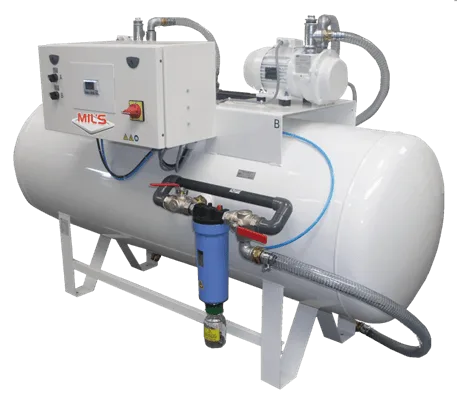
Match the equipment to the laboratory duty
| Duty | Starting point | Selection priorities |
|---|---|---|
| Shared laboratory vacuum utility | MIL’S LABOVAC | Simultaneous demand, liquid-ring operating conditions, water services, distribution losses and filtration. |
| A dedicated dry vacuum requirement | KNF equipment enquiries and Vacuubrand equipment enquiries | Wetted-material compatibility, vapour load, achievable pressure and control. Specify the exact chemically compatible version. |
| High-vacuum chamber or instrument | Turbomolecular pumps and suitable backing equipment | Target pressure, gas load, chamber connections, backing conditions, controller and protection interlocks. |
LABOVAC: a laboratory utility system
The MIL’S LABOVAC range combines liquid-ring pumping, a receiver and regulation. The manufacturer describes water-management equipment and optional bacterial filtration. Ask which components are included in the specific configuration; optional filtration should not be assumed to be fitted.
The existing S26/1 listing is a legacy model reference. Send the full nameplate when requesting a replacement. A similar current model number does not establish identical flow, motor power or receiver capacity.
Five details that make an enquiry useful
- Pressure and flow: state the required absolute pressure, gas load or evacuation time, and how many outlets operate together.
- What enters the line: identify gases, solvents, moisture, particles and any biological or hazardous material. Share the relevant process information for compatibility review.
- Available services: include electrical supply, cooling or seal-water services where applicable, exhaust arrangements and installation space.
- Control: describe regulation, alarms, interlocks and any need for continued service during maintenance.
- Measurement: specify the useful range, output, controller and calibration requirements.
Choose measurement alongside the pump
A Pirani transducer and a combined high-vacuum gauge cover different duties. Gas-dependent instruments also need their response assessed for the gases being measured. Use the gauge selection guide before choosing a sensor by its display or connection alone.
If the result must be traceable, include the pressure points and certificate requirements in a calibration enquiry. Calibration scope and any accredited coverage are confirmed for the requested work.
Laboratory vacuum questions
Can one vacuum system serve the whole laboratory?
A shared supply may suit compatible utility duties. Solvent handling, contamination-sensitive work and high-vacuum experiments may need separate equipment. Use our central system guide to describe demand and discuss which processes can share a line.
Is LABOVAC a high-vacuum system?
LABOVAC is a liquid-ring laboratory utility range. For a high-vacuum chamber, start with turbomolecular equipment and a compatible backing arrangement. Select against the actual pressure and gas load, not the word “laboratory”.
Can I order a gauge, controller and calibration together?
Yes. Add the measurement equipment to your shortlist and explain which items form the measuring chain. Include your test points and certificate requirement so the scope can be confirmed.
Discuss a laboratory vacuum requirement
Tell us what the equipment will do, what it will handle and the pressure you need. For a replacement, include the complete model reference and existing services.
LABOVAC manufacturer catalogue excerpt (PDF, February 2022). Refer to the exact model and version when comparing data.
Technical basis: MIL’S trilingual catalogue, February 2022, LABOVAC section (printed page 26), and the linked Girovac equipment listings. Application selection remains specific to the process and exact equipment version.