

A rising pressure does not automatically mean a vacuum system has a leak. Gas may enter through an unintended path, or come from materials already inside the chamber. Both increase the load on the pump.
Finding the cause matters: tightening connections will not remove moisture from surfaces, and extended pumping will not repair a damaged seal.
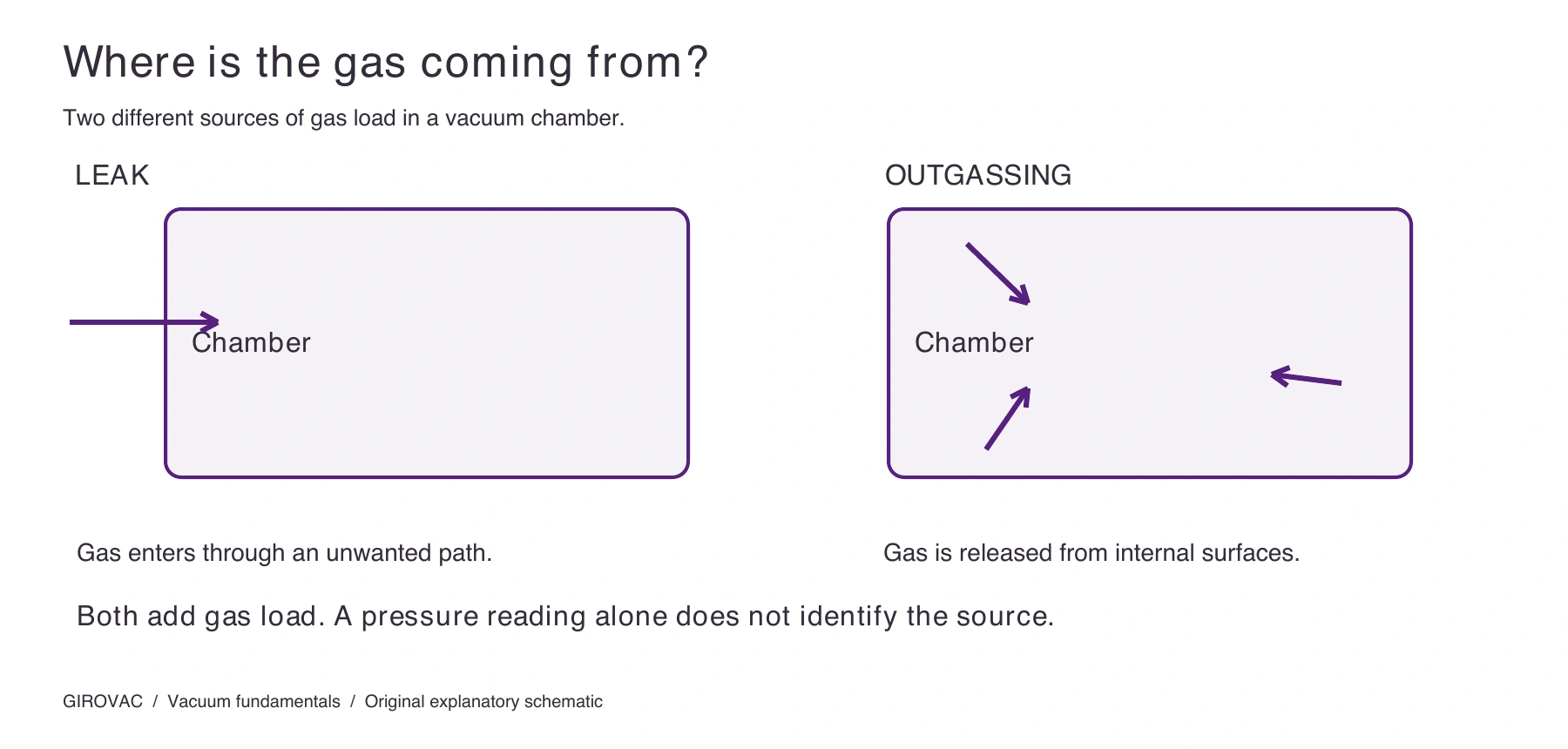
Where is the gas coming from?
A real leak provides a path into the evacuated system through a seal, joint, weld or damaged component. Outgassing releases gas from internal materials, including chamber walls, samples and contamination.
A trapped volume can also release gas slowly through a restricted passage, producing a virtual leak. Gas may permeate through some materials without a discrete hole. Several sources can operate together.
What does the history tell you?
If performance changed after a flange was opened, investigate that connection. If the chamber spent a long time in humid air, a larger moisture load is plausible. A new sample, adhesive or fitting may introduce gas absent from previous runs.
A gradually developing problem can also involve contamination, pump condition or measurement. These clues direct testing; they do not establish the cause by themselves.
What a pressure-rise test measures
In a suitable system, the test measures how quickly pressure increases after the evacuated chamber is isolated from the pump. For a fixed volume at approximately constant temperature, with negligible remaining pumping or gas capture, average net gas load is estimated as:
Gas load = volume × pressure rise ÷ elapsed time
Suppose an isolated 10-litre volume rises from 0.001 to 0.004 mbar in 60 seconds. The estimated net load is 10 × (0.004 − 0.001) ÷ 60 = 0.0005 mbar·l/s.
This is an illustrative gas-load estimate. It is not a confirmed leak rate unless other contributions have been shown to be negligible. Include connected spaces in the volume and use a gauge suitable for the gas and pressure range. The isolation arrangement must also be understood.
Can the curve help?
A stable leak under roughly constant conditions can produce an approximately steady rise. Outgassing often diminishes with pumping time, so repeated comparable tests may show a reduced load.
In practice, outgassing can also produce a straight section of a pressure-rise curve. Both sources may be present, while temperature changes and gauge behaviour complicate interpretation. Repeated controlled measurements are more informative than a single reading, but are not a definitive diagnosis.
When tracer-gas testing helps
In a suitable helium test, helium applied outside an evacuated component is detected after entering it. A repeatable response associated with a location helps identify an external leak path.
Controlled application, sufficient response time and an established background are essential. Excess helium in the surroundings complicates interpretation. An absence of response means no leak was detected under those conditions; it does not exclude every possible path. The helium leak-testing guide explains local and integral methods.
Keep a record before changing the system
Record pressure against time, previous pumping duration, temperature and whether the chamber was empty or loaded. Include recent exposure to atmosphere, valve positions and gauge location. Without these details, comparisons may be misleading.
Send Girovac the record with the pump and gauge models, process details and maintenance history. This helps establish useful further checks before replacing parts.
Technical reference: Leybold, Fundamentals of Vacuum Technology, 2016 edition, sections 2.3.1.2, 5.1 and 5.4.1. Leybold’s online vacuum fundamentals provides further reading.
Updated September 2026. Model-specific settings and limits must be checked against the equipment’s operating instructions.