

Outgassing is the release of gas or vapour from materials inside a vacuum system. It adds to the load the pump must remove, so pressure can keep falling slowly long after most of the original air has gone.
Chamber walls are one source. Seals, fittings, samples and other internal materials contribute too.
An empty chamber still has a gas load
A chamber that looks empty may have water and other molecules attached to its surfaces after exposure to room air. Some remain on the surface through adsorption. Others enter the bulk of a material through absorption.
During evacuation, surface molecules can detach, or desorb. Gas within a material may first diffuse to the surface before leaving it. Materials with appreciable vapour pressure can also release vapour.
These processes occur at different rates. Their combined effect depends on material, temperature, previous exposure and pumping time.
Why pressure falls quickly, then slowly
Early in evacuation, the pump removes gas occupying the chamber volume. Later, gas released from surfaces and materials can account for a larger proportion of the load. The system continues to receive gas internally even without an admitted process flow.
Two apparently identical runs may therefore take different lengths of time. One chamber may have been open briefly; another may have spent hours exposed to humid air. A change of sample matters too.
The pressure curve alone does not prove outgassing is the cause. Leaks, measurement issues and pump condition also need consideration.
Which materials matter?
A chamber with extensive internal fittings presents more surface than its outside dimensions suggest. Polymers, elastomer seals, adhesives and porous materials may introduce significant loads, depending on composition and preparation.
Metals also release gas. Stainless steel still needs appropriate cleaning, handling and preparation. Published outgassing figures are useful only with their conditions attached: a value measured after prolonged pumping or heat treatment is not a universal material property.
What can reduce it?
For new systems, consider material selection and internal surface area during design. For existing equipment, suitable measures may include cleaning, protecting prepared components, limiting unnecessary exposure to room air and allowing sufficient pumping time after opening.
Where the complete assembly permits it, a specified bake-out procedure can encourage gas release while the system is evacuated. Pressure may rise during heating as more gas enters the chamber.
The temperature limit depends on the whole assembly, including gauges, seals, valves and internal components. A temperature suitable for the metal chamber may exceed the rating of an attached part.
Would a larger pump help?
It can, provided the extra speed reaches the chamber. At a steady operating point, where the pump’s own limiting pressure is negligible, pressure is approximately gas load divided by effective pumping speed.
The connection may restrict the benefit, and the gas load itself may be avoidably high. Cleaning, material changes or a preparation procedure can address the underlying problem more effectively. The pipework guide explains why pump size alone can be misleading.
Outgassing or a leak?
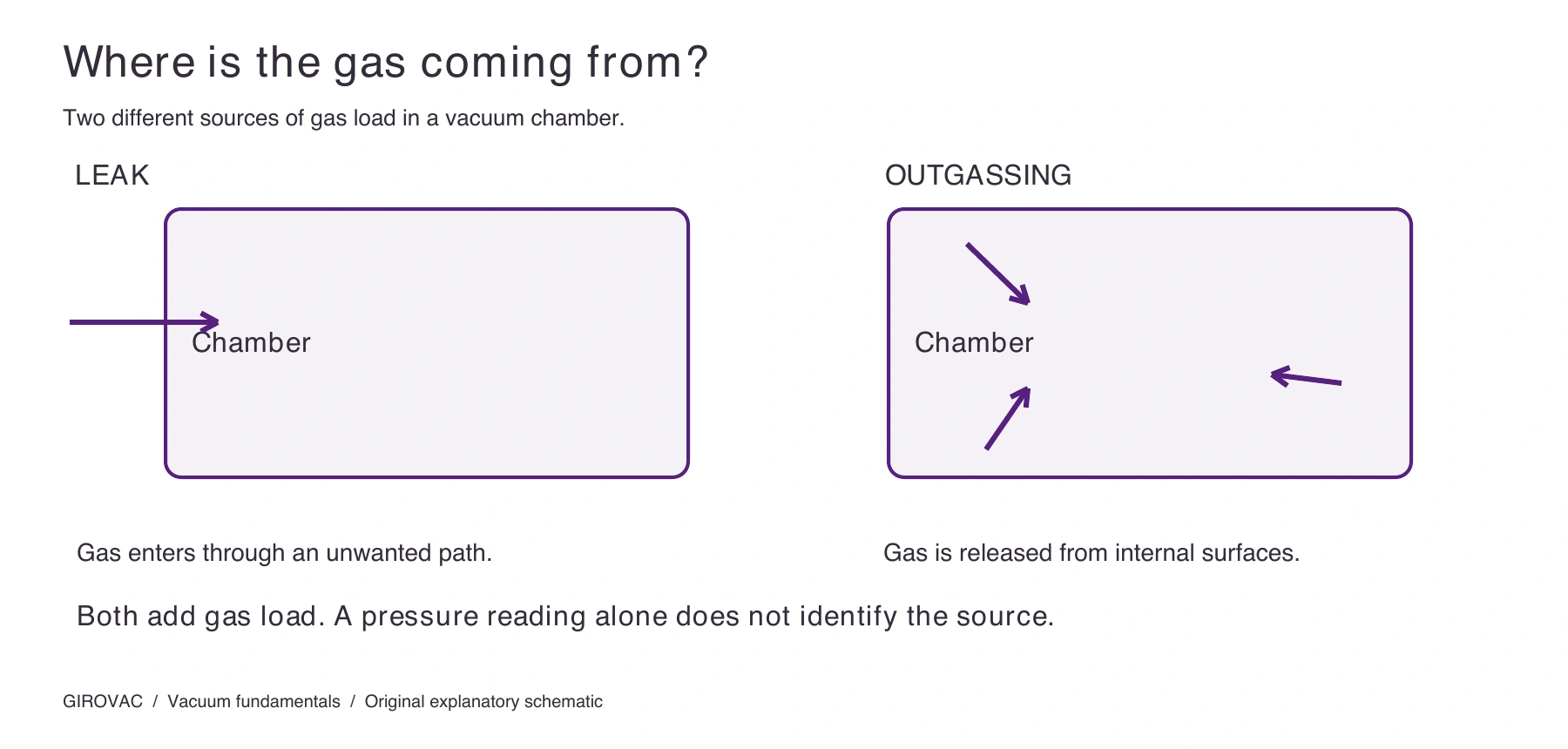
A leak admits gas through an unintended path; outgassing releases it from internal materials. Both may be present. A pressure-rise test can help assess the total load, but part of an outgassing curve can resemble a leak response. See how to distinguish leaks from outgassing for the limits of that test.
If evacuation has slowed, record how long the chamber was open, its contents and how pressure changed during pumping. Send Girovac the record with the pump and gauge details.
Technical reference: Leybold, Fundamentals of Vacuum Technology, 2016 edition, sections 1.1, 2.2.6, 2.3.1.2 and 5.4.1. Leybold’s online vacuum fundamentals provides further reading.
Additional reference: High, Ultra-high & Extreme High Vacuum: The fundamentals, June 2024, pages 4–6.
Updated September 2026. Model-specific settings and limits must be checked against the equipment’s operating instructions.